Showing posts with label senior dog. Show all posts

Wednesday, May 13, 2020

R.I.P Dear GiGi

Rest in Peace now dear GiGi.
Unfortunately we had to help her cross the Rainbow Bridge.


GiGi came to us three years ago from Grant County Humane Society, Elbow Lake, Minnesota.
She had Lyme disease but she was a happy doggie.
We had good times together and she loved all the cats here too. Her favorite things was rolling in the fresh grass or fresh fluffy snow. We loved our walks together and I loved her soothing snoring when she was sleeping.

Unfortunately, about two weeks ago she started to have accidents in the house, mostly on her bed during the night. She would be asleep and just poop. She seemed to get lost in the yard and disoriented. She also did not like to go out in the dark early mornings anymore. Soon after we suspected that her eyes sight had gotten worse. She still felt safe walking close near me. The cats knew that something was wrong.


Suddenly, two days ago she stopped eating and drinking. She refused her medicine and even her favorite treats. A day later she was not able to stand up nor walk.


We had to come to a hard decision to take her to the vet on May 4th, 2020. Around 11:45 AM she passed quickly and peacefully. As GiGi crossed over the Bridge she stole a piece our hearts. 

Tuesday, March 24, 2020

Crosby's Story


Crosby was our daughter Susan's dog but he often visited us here in the countryside. Susan adopted him from a pound in the state of Washington. The poor thing had an emotional disorder (Separation Anxiety) so sometimes he was destroying things in their apartment and not just objects but even the carpets. Barking all the time without rest when he was alone and generally driving himself to such stressful states it was unhealthy for him too.
There was times when she was ready to find a new home for him but it never happened because somehow they bonded as kindred spirits. So he stayed with her and she always hoped he would mellow with time.
When Susan ended the relationship with her boyfriend, we asked her to move closer to us. We felt she needed a big change and a new place with family near her would do nicely. She was a bit apprehensive but took the leap of faith and even went back to school for a new career path. She bought a small house and started her online college for 2 years. Crosby and her loved to visit us on our peaceful property out on the country, where Crosby was happy and free running like a puppy again. At the time we had Rosie and they became good puppy friends.


Since they lived seven miles away from us, they would visit frequently. As we grew close and had the opportunity to notice that Crosby's hearing and eyesight was getting weak. Soon after that he started pacing incessantly until he got tired and fell into sleep. His anxiety which had lessened as the years went by started to come back. Not separation but something else. Then his joints were creaking more and more as stiffness set on. Arthritis was surely present too. His happy running got slower in the big yard.


Susan took him to the vet and they said he was just getting older. He started to drink a lot of water and was having accidents in the house. The poor old puppy was just wearing out. One morning she had that feeling and sent me a text message saying; Mom, I think it's time. She sent me a video how Crosby walked around and around in tight circles. His doggie dementia had gotten much worse in a short space of time. She made an appointment for Crosby's peaceful passing.


Half of his ashes placed near Rosie's and Tommy's grave and for all the memories how much he loved running around here in the countryside. He has been released from his long years of friendship and service to Suzie and his family. He is at peace eternal and awaits all his fur and human family to run and bounce with joy.


Who's a good boy? Crosby is.

Monday, February 10, 2020

Can Your Pet Help You Be Healthier?


Besides the obvious value of a good snuggle, what’s the connection between pets and our health? Studies have shown pet ownership may help increase fitness levels, relieve stress, lower blood pressure and cholesterol levels, and boost overall happiness and well-being. Pets also provide social support, which is an important factor in helping you stick with new healthy habits.
It’s no surprise that people who walk their dogs are more likely to get the recommended amount of physical activity than those who don’t. One study found that pet owners who walk their dogs got up to 30 minutes more exercise a day than non-walkers.
Try these tips for being active together:

  • Go on a picnic. Pack some healthy snacks such as fruit, veggies, mixed nuts and plenty of water (including a bowl for the pup). Bring a ball or other fun toys.
  • Cool off in the sprinklers. When it’s hot, grab swimsuits and sunscreen and run around in the cooling spray with your kids and pooch.
  • Take a dip. If you live near a dog-friendly beach, lake or pool, jump in!
  • Go for a walk. Participate in local fundraising walks (like the Heart Walk) or fun runs with the whole family. Check to make sure dogs are allowed. You’ll be getting active together while supporting a great cause.
  • Park it. If your dog plays well with others, hit up the local dog park.
  • Play ball. Head outside anytime to enjoy some fresh air and a quick game of fetch or keep-away. Even if you only have 10 or 15 minutes, you and your dog will get some exercise and bonding time.
  • Walk home from school. Dogs and kids will be excited to see each other after a long day apart, and the trip home gets a lot more fun.

Your dog — and your heart — will thank you!

Welcoming a dog into the family is a big decision with big responsibilities — and many wonderful benefits. And if you end up getting more active with your new loving companion, it’s a win-win.
Bottom line: Being more active and less stressed can help you live a longer, healthier life with your pet.

Friday, January 3, 2020

GiGi's Story


Many Animal rescues are saying that they are not judging people who can not take care of their pets any longer. Well, Rosegate has a total different view of this. We are not sugar coating, simple is that...
You took those pets into your life and home. If any situation comes up that you do not want to take care of them any longer, you are a jerk. There is always a way to solve a problem. I wonder how many of you would throw your children or parents away, put them to sleep or take them to the orphanage? Probably not a single one. Same thing with pets. When you brought that innocent critter into your life, you should've know that they are a lifetime commitment.
Here's a story of GiGi, a black lab we gave a forever home to. GiGi probably was a cute, chubby Christmas present (just sayin' since the holidays passed recently) given to someone more than a decade ago. Then she grow big, ate a lot, and was no longer the apple of their owners eye. She was left to be alone, unattended on a farm, infested by fleas and ticks.When she became sick from a tick bite, her owner tried to be rid of her. She was given to the neighbors. They then in turn passed her off to other people and then she was dumped at the shelter.
She was 12.5 when I found her in a shelter near us. Her slightly white and sad face melted our hearts. We took a ride to check her out and she was the only friendly dog in the shelter's kennels. She wiggled her tail and licked our hands. It didn't take us too long to decide and she became our newest member of the family. She has Lyme disease and probably the last owner was not able to afford her medicine. That's how she ended up in the shelter at her senior age. The truth about her disease is not even that terrible. Good veterinary care, an annual Lyme vaccine, some antibiotic 1-2 times a year and this makes her condition lessened to the point where she is a happy dog again.
GiGi is so gentle and loving and she has no problem with sharing her bed with the cats or let the cats try her food first. She is about 15-16 years old with weak hearing and her vision has diminished but she is as happy as can be.

Read Article:


Lyme disease is a very common infectious disease in the northeast United States. It is also a very controversial topic amongst veterinarians because most dogs that test positive are not clinically ill. This makes it difficult to determine which dogs should be treated. Lyme disease also affects humans, so it is a topic of interest to everyone. The purpose of this article is to answer some commonly asked questions about Lyme disease and clear up some common misconceptions. Lyme disease is caused by the spirochete bacteria Borrelia burgdorferi. The disease is transmitted to humans and dogs by the nymph and adult stages of the black-legged tick, Ixodes scapularis.

If my dog tests positive, does this necessitate treatment?

The answer to this will vary from dog to dog, and remains a point of controversy. Only about 10% of positive dogs will ever develop clinical illness from infection with the Lyme organism, so many veterinarians argue that treatment is not necessary for seemingly healthy dogs. Today we are fortunate to have two Lyme tests that assist us in determining if the infection is active / recent. If your dog tests positive on a screening test, you should discuss additional testing with your veterinarian to determine if treatment is warranted. In endemic areas (including Massachusetts), annual screening tests for Lyme disease are recommended.
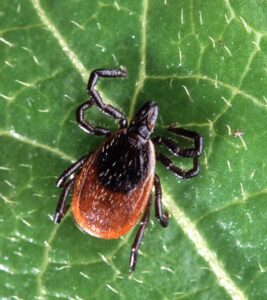
Adult deer tickIf your dog does develop clinical illness from Lyme disease, the most common signs are lameness, fever, lethargy, and enlarged lymph nodes. Clinical illness is expected 2-5 months after infection. The majority of dogs respond very well to antibiotic treatment with Doxycycline or Amoxicillin.

Black-legged ticks are small, so if I find a large tick on my dog, he/she can’t get Lyme disease, correct?

The larval and nymphal stages of all ticks are small, but an engorged adult tick can be quite large, so a lab would need to identify the tick to be sure your dog has not been bitten by a black-legged tick.

If I find a tick on my dog, should I go to the vet

If you are comfortable removing the tick, you do not need to see your vet. The best way to remove a tick is to use tweezers to grab the tick as close to the skin as possible. The tick should then be removed by pulling straight out. Do not twist or crush the tick as you are removing it. Wash your hands after removing the tick to limit possible exposure to yourself.

How long does the tick need to be attached to transmit infection?

For Lyme disease to be contracted, the tick must be attached to your dog for at least 48 hours. Therefore, the best means of avoiding Lyme disease is to remove ticks as soon as they are found. Daily inspections of your dog are recommended, especially if they have been in wooded areas. In addition to “tick checks,” we also strongly recommend topical parasiticides such as Frontline or Advantix (dogs only). There are several other tick products available, so please discuss the appropriate choice with your veterinarian. Be sure to avoid bathing or swimming for 24 hours after application of these topical products. Follow the application guidelines carefully for best efficacy.

Once a frost occurs, I don’t have to worry about ticks anymore until the following spring, correct?

Wrong. Adult ticks are active whenever the weather approaches or exceeds freezing. If there is snow cover, there won’t be much if any tick activity, but if we have several warm winter days in a row, the ticks may be active.

Can I get Lyme disease from my dog?

No, Lyme disease is not a zoonotic disease, meaning it cannot be directly transmitted from your dog to you. However, if a tick crawls off your dog and bites you, you can become infected.

Should I vaccinate my dog against Lyme disease?


There are several canine vaccines available to prevent Lyme disease. The need for this vaccine should be determined on a case by case basis following a discussion with your veterinarian. We recommend that all dogs be tested for Lyme disease before considering a vaccine. Some opponents of vaccination fear that if your dog is vaccinated and still contracts the disease, the symptoms will be worse. However this is based on experience with the human vaccine (no longer on the market), and has not been proven in dogs.

Do Your Homework Before Euthanasia


Almost 5 years ago, Rosie was misdiagnosed by her vet. The vet said it's a stroke and it will only get worse but in fact Rosie had Vestibular Disease. The vet recommended euthanasia, and we trusted her professional advice. Big mistake. Rosie could have had more time left with us by just giving her some medicine. Unfortunately the vet was unaware of this condition and diagnosed the most apparent cause. You know your pet better than anyone and will have observed the situation before rushing off to the vet. All your vet will have to go on is what you tell them and what they see right there in the moment. After that it might be a snap decision on their part.
Always do your homework and communicate with other pet owners and especially rescues that have a good history. Please don't run off and make a bad decision based on a panic

The following article was borrowed from a fellow Rescue Group


Vestibular disease in dogs is commonly referred to as “old dog disease” because it primarily happens to older dogs. If anyone has seen Vestibular disease in dogs it can be very scary. The dog becomes disoriented, vomits, falls over, walks in circles, bumps into things and seems to be having a stroke. Rapid eye movement is also apparent in many dogs during a Vestibular episode.
So what is Vestibular disease in dogs? The Vestibular system is comprised of components in the brain as well as peripheral components in the middle and inner ear. VCA hospitals describe Vestibular disease as a sudden disturbance in balance. But to the untrained eye, the symptoms may mimic serious, life threatening conditions such as a stroke or a brain tumor. When a dog has a Vestibular episode it can be very scary for you and your dog.
Idiopathic Vestibular Disease is Vestibular Disease where they can’t find a cause, and can be recurring. Most episodes can last hours to several days. The symptoms may vary from dog to dog.

Symptoms of Vestibular Disease and What Will Occur During a Vestibular Episode


  • Head tilting – Head tilt may last longer after the VD episode – Head tilt maybe permanent
  • Nausea and sometimes vomiting
  • Confusion
  • Stumbling or inability to walk
  • Walking in circles or rolling
  • Rapid eye movement
  • Bumping into things
  • Sitting and seeming dazed
  • leaning on you or walls
  • Lethargy and desire to sleep on hard floor instead of bed
  • Loss of appetite

What Your Dog Is Feeling During a Vestibular Episode


As scary as a Vestibular episode can be, your dog is not in pain, but your dog is very nauseous and confused. He or she likely has vertigo and their world is spinning. Your dog may be very scared. I describe it as the feeling someone gets when they have drank way to much alcohol. If your dog is having it’s first episode take him or her to the vet right away. It could be something more serious. Do not assume it’s Vestibular Disease, always get a professional diagnosis.

Treating Idiopathic Vestibular Disease


Do not treat your dog until you have taken your dog to the vet to verify that your dog has Vestibular Disease. Your vet can also determine if your dogs Vestibular Disease is idiopathic (without Cause) or if something else is causing your dogs Vestibular Disease.
Dogs should treat with Vestibular episodes with an anti-nausea prescription form our vet, some people have used OTC Dramamine with great success. We then give Valium to calm her down and a Rimadyl as an anti-inflammatory since there is evidence that VD can be caused by inflammation. She has responded so well to treatment that within a few hours she is right back to normal.
It is also recommended that your urge to carry your dog around during an episode may prolong the episode. The more he/she walks around on his or her own the quicker the inner ear may stabilize itself. Create a safe area for your dog during this time. Maybe limit roaming area to one or two rooms of the house.
Make sure that your dog does not attempt stairs during an episode. We recommend not leaving your dog alone during an episode. If you have stairs into your home carry your dog up and down the stairs. Block all stairways in the home to protect your dog. Start treatment immediately. Remember, nothing seems normal and eye sight is impaired during an episode. Watch your dog closely, if the stress is too much, or they are vomiting and at risk of dehydration they may need veterinarian involvement including; IV fluids, sedation and nutrition in more severe cases. Sadly, some dogs are so distressed and their episodes last so long that owners decide to euthanize the dog, however, this is very rare.

Non-Idiopathic Vestibular Disease


Non-Idiopathic Vestibular Disease is a little different, because there is a cause for the Vestibular Disease like head trauma, ear infection or trauma, tumors, certain medications and hyperthyroidism may all cause Vestibular Disease. It is always important to check with your vet before ever treating your dog. Do not self diagnose please. Often the treatment is the same, however, it may include an antibiotic, surgery, or some other treatment once the cause is found. Do not assume your dog has idiopathic Vestibular Disease until your dog has been completely vet checked.

The Good News


As scary as it is to watch a dog having a Vestibular Disease episode, it is not fatal, your dog is not in physical pain, and there is a really good chance that the episode won’t last very long. Start treatment immediately for best results. Vestibular Disease in older dogs is pretty common but can happen to a dog of any age. Keep your dog close and safe and soon your will have your furry buddy back to normal.