Showing posts with label lyme disease. Show all posts

Saturday, October 17, 2020

Top 3 Reasons To Avoid The Lyme Disease Vaccine For Dogs


Ticks are a terrifying reality for most dog owners. 

They are parasites that latch onto a host animal, embed themselves into the skin and suck on blood. This makes the tick the perfect carrier for a variety of pathogens. 

In fact, ticks are responsible for at least ten different known diseases in the US, including:

Most of this is information that you likely already know. And why your vet often recommends the Lyme vaccine for dogs.

But did you also know that it’s one of the most dangerous vaccines you can give your dog?

Like other vaccines, the Lyme vaccine can cause allergies, cancer and organ disease.

And don’t think you’re in the clear if your dog doesn’t show any of these signs the week after he’s vaccinated …

… vaccine damage can take months or even years to develop.

That is why it’s so important for you to understand what the vaccine is before you get it for your dog.

Once you vaccinate for Lyme disease, you can never reverse that decision … or the damage it can cause.

Before you rush to your vet for that Lyme vaccine, read my top 3 reasons why the Lyme vaccine for dogs is risky business …

#1 – The Lyme Vaccine Can Cause Lyme Disease Symptoms

Holistic vet Dr Patricia Jordan urges pet owners to avoid the Lyme vaccine for their dogs. She claims the Lyme vaccine is more dangerous than Lyme disease:

“There is no justification for taking this serious vaccination risk with our dogs. The Lyme vaccine is all risk and no benefit. There is a high chance of severe adverse events … like a lifetime of non-treatable arthritis pain just for getting the jab in the first place.”

And Dr Michael Garvey of the Animal Medical Center agrees. He says dogs can develop Lyme-like symptoms. And it can happen days or even weeks after vaccination.

Dr Jordan also explains that cells in the immune system can react with the antigens in the Lyme vaccine. This causes Lyme nephritis (kidney disease) … which is ironic, because Lyme nephritis is the reason your vet wants to give your dog the vaccine!

This is why none of the US veterinary schools list the Lyme vaccine as one of their recommended vaccines.

#2 – The Lyme Vaccine Contains Dangerous Ingredients

Kidney disease isn’t the only risk that comes with the Lyme vaccine.

Vaccines carry harmful chemicals and heavy metals like:

  • formaldehyde
  • aluminum
  • mercury
  • thimerosal

You see, vaccines carry live or inactivated viruses. But the amount is so small that the immune system won’t recognize. These chemicals are added to create an exaggerated immune response to the virus.

And there are two problems with this …

1.     This type of chaos in the immune system can carry some serious issues. It can cause hypersensitivity disorders. Hypersensitivity is chronic inflammation, which can result in allergies, cancer and organ failure.

2.     Aluminum and thimerosal can travel to the brain and cause inflammation there. If you’ve ever had a reactive or fearful dog, you might not have considered his vaccines as a cause.

Still don’t believe me?

There was a human Lyme vaccine called LYMErix back in the 90s. 3 years after it went on the market, Smith Kline Beecham withdrew LYMErix amidst a class action suit. The class action suit came from a sea of allegations of adverse effects including:

  • suicide
  • deaths
  • arthritis
  • rheumatoid arthritis
  • facial paralysis
  • hypersensitivity reactions
  • myalgia
  • heart disease
  • kidney disease
  • and more

Most of the patients developed an incurable form of autoimmune arthritis. And that was worse than the arthritis caused by Lyme.

So if the Lyme vaccine isn’t safe for humans, why would you give it to your dog?

#3 – Most Dogs Don’t Get Lyme Disease Symptoms … Even When They Have Lyme Disease

In 2006, researchers at the University of Pennsylvania infected beagles with Lyme disease.

None of the adult dogs showed any signs of Lyme disease … even though they had Lyme disease.

The only dogs in the group that showed any signs of Lyme disease were the puppies … and after four days of on and off symptoms, every puppy showed no signs of Lyme disease.

This is likely because puppies have immature immune systems. So while Lyme is common, the disease isn’t.

But what about dogs who already test positive for Lyme?

Meryl Littman was the lead researcher and explains … “95% of exposed dogs don’t get sick, but they become Lyme antibody-positive on tests, which may scare people into thinking they need to be treated.”

In fact, 70% – 90% of dogs in some areas of New England test positive for Lyme. About 40% of dogs in Pennsylvania test positive.

Should You Get The Lyme Vaccine For Your Dog?

I can’t tell you what to do … although there are a lot of folks who try to …

If you visit the Pets & Parasites website, you’ll see some pretty scary things like this …


Friday, January 3, 2020

GiGi's Story


Many Animal rescues are saying that they are not judging people who can not take care of their pets any longer. Well, Rosegate has a total different view of this. We are not sugar coating, simple is that...
You took those pets into your life and home. If any situation comes up that you do not want to take care of them any longer, you are a jerk. There is always a way to solve a problem. I wonder how many of you would throw your children or parents away, put them to sleep or take them to the orphanage? Probably not a single one. Same thing with pets. When you brought that innocent critter into your life, you should've know that they are a lifetime commitment.
Here's a story of GiGi, a black lab we gave a forever home to. GiGi probably was a cute, chubby Christmas present (just sayin' since the holidays passed recently) given to someone more than a decade ago. Then she grow big, ate a lot, and was no longer the apple of their owners eye. She was left to be alone, unattended on a farm, infested by fleas and ticks.When she became sick from a tick bite, her owner tried to be rid of her. She was given to the neighbors. They then in turn passed her off to other people and then she was dumped at the shelter.
She was 12.5 when I found her in a shelter near us. Her slightly white and sad face melted our hearts. We took a ride to check her out and she was the only friendly dog in the shelter's kennels. She wiggled her tail and licked our hands. It didn't take us too long to decide and she became our newest member of the family. She has Lyme disease and probably the last owner was not able to afford her medicine. That's how she ended up in the shelter at her senior age. The truth about her disease is not even that terrible. Good veterinary care, an annual Lyme vaccine, some antibiotic 1-2 times a year and this makes her condition lessened to the point where she is a happy dog again.
GiGi is so gentle and loving and she has no problem with sharing her bed with the cats or let the cats try her food first. She is about 15-16 years old with weak hearing and her vision has diminished but she is as happy as can be.

Read Article:


Lyme disease is a very common infectious disease in the northeast United States. It is also a very controversial topic amongst veterinarians because most dogs that test positive are not clinically ill. This makes it difficult to determine which dogs should be treated. Lyme disease also affects humans, so it is a topic of interest to everyone. The purpose of this article is to answer some commonly asked questions about Lyme disease and clear up some common misconceptions. Lyme disease is caused by the spirochete bacteria Borrelia burgdorferi. The disease is transmitted to humans and dogs by the nymph and adult stages of the black-legged tick, Ixodes scapularis.

If my dog tests positive, does this necessitate treatment?

The answer to this will vary from dog to dog, and remains a point of controversy. Only about 10% of positive dogs will ever develop clinical illness from infection with the Lyme organism, so many veterinarians argue that treatment is not necessary for seemingly healthy dogs. Today we are fortunate to have two Lyme tests that assist us in determining if the infection is active / recent. If your dog tests positive on a screening test, you should discuss additional testing with your veterinarian to determine if treatment is warranted. In endemic areas (including Massachusetts), annual screening tests for Lyme disease are recommended.
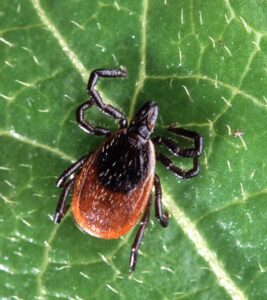
Adult deer tickIf your dog does develop clinical illness from Lyme disease, the most common signs are lameness, fever, lethargy, and enlarged lymph nodes. Clinical illness is expected 2-5 months after infection. The majority of dogs respond very well to antibiotic treatment with Doxycycline or Amoxicillin.

Black-legged ticks are small, so if I find a large tick on my dog, he/she can’t get Lyme disease, correct?

The larval and nymphal stages of all ticks are small, but an engorged adult tick can be quite large, so a lab would need to identify the tick to be sure your dog has not been bitten by a black-legged tick.

If I find a tick on my dog, should I go to the vet

If you are comfortable removing the tick, you do not need to see your vet. The best way to remove a tick is to use tweezers to grab the tick as close to the skin as possible. The tick should then be removed by pulling straight out. Do not twist or crush the tick as you are removing it. Wash your hands after removing the tick to limit possible exposure to yourself.

How long does the tick need to be attached to transmit infection?

For Lyme disease to be contracted, the tick must be attached to your dog for at least 48 hours. Therefore, the best means of avoiding Lyme disease is to remove ticks as soon as they are found. Daily inspections of your dog are recommended, especially if they have been in wooded areas. In addition to “tick checks,” we also strongly recommend topical parasiticides such as Frontline or Advantix (dogs only). There are several other tick products available, so please discuss the appropriate choice with your veterinarian. Be sure to avoid bathing or swimming for 24 hours after application of these topical products. Follow the application guidelines carefully for best efficacy.

Once a frost occurs, I don’t have to worry about ticks anymore until the following spring, correct?

Wrong. Adult ticks are active whenever the weather approaches or exceeds freezing. If there is snow cover, there won’t be much if any tick activity, but if we have several warm winter days in a row, the ticks may be active.

Can I get Lyme disease from my dog?

No, Lyme disease is not a zoonotic disease, meaning it cannot be directly transmitted from your dog to you. However, if a tick crawls off your dog and bites you, you can become infected.

Should I vaccinate my dog against Lyme disease?


There are several canine vaccines available to prevent Lyme disease. The need for this vaccine should be determined on a case by case basis following a discussion with your veterinarian. We recommend that all dogs be tested for Lyme disease before considering a vaccine. Some opponents of vaccination fear that if your dog is vaccinated and still contracts the disease, the symptoms will be worse. However this is based on experience with the human vaccine (no longer on the market), and has not been proven in dogs.